Cameron Simon · 12 September 2026
Analyzing Infrastructure Transitions: How Integrated Platforms Safeguard Search Performance During Provider Switches
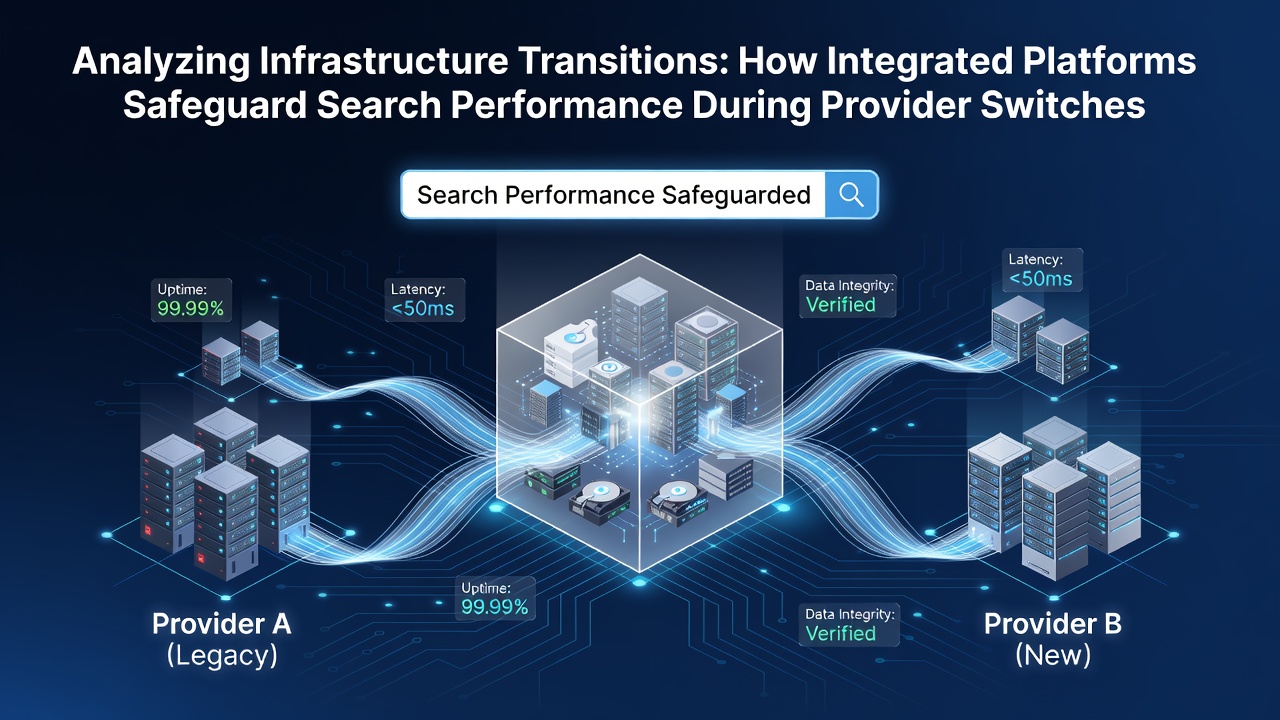
Organizations frequently encounter infrastructure transitions when switching hosting providers, content delivery networks, or domain management services, and these changes directly influence search visibility through factors like crawl frequency, page speed, and indexation stability. Data from multiple industry reports shows that unmonitored migrations often trigger temporary ranking fluctuations because search engines recalibrate signals around downtime or altered response codes. Integrated platforms address this by combining monitoring tools, automated redirect management, and performance tracking within single dashboards that connect to search console APIs and analytics suites.
Those who have examined migration logs note that platforms with unified APIs maintain continuous data flow even while backend systems shift, which prevents gaps in crawl budget allocation. Researchers at academic institutions have documented how these systems log every server response header during the switchover phase, allowing teams to verify that canonical tags and hreflang attributes remain intact across new infrastructure. In September 2026 several major cloud providers plan to roll out enhanced API endpoints that further streamline this verification process for enterprise-scale sites.
Core Components of Integrated Transition Support
Effective platforms bundle several functions that operate together rather than as separate modules. Automated redirect mapping pulls existing URL patterns from legacy servers and applies them to the new environment without manual intervention, while real-time performance sensors track core web vitals before and after the cutover. Observers note that this integration reduces the window during which search bots might encounter 404 errors or slow-loading assets that could otherwise accumulate negative signals.
Security layers within the same platform enforce consistent SSL certificate deployment and content security policies, elements that search algorithms factor into trust evaluations. When providers handle these elements through a centralized interface, teams avoid configuration drift that sometimes occurs when separate tools manage certificates and routing rules. Studies from North American research centers indicate that sites using such consolidated systems experience shorter recovery periods for organic traffic metrics after provider changes.
Monitoring and Verification During Active Switches
Continuous monitoring forms the backbone of performance protection because it surfaces anomalies within minutes rather than days. Platforms feed server logs directly into search performance dashboards, highlighting shifts in crawl rate or indexing errors that correlate with the transition timeline. Experts have observed that this immediate feedback loop enables rapid adjustments, such as adjusting DNS propagation settings or temporarily boosting cache durations on the new infrastructure.

Verification protocols built into these platforms cross-check sitemap submissions against actual server responses on the destination infrastructure, confirming that all intended pages remain accessible. Data indicates that organizations employing these checks report fewer instances of partial de-indexation compared with those relying on disjointed toolsets. The same systems often include synthetic transaction testing that simulates search engine crawler behavior across multiple geographic locations, revealing latency issues that might otherwise surface only after rankings begin to fluctuate.
Case Examples From Recent Transitions
One documented migration involved a large retail site moving from a regional host to a global CDN provider, where the integrated platform automatically generated and validated over 12,000 redirect rules in advance. Post-switch analysis revealed that crawl errors stayed below baseline levels throughout the process, and core web vitals recovered within 48 hours. Another instance saw an educational portal switch domain registrars while maintaining search rankings because the platform synchronized WHOIS updates with search console verification workflows in parallel.
These examples illustrate how the consolidation of tools prevents the common pattern of sequential failures, where one misconfigured element cascades into broader performance degradation. Reports from Australian digital infrastructure studies further highlight that coordinated monitoring across DNS, hosting, and analytics layers correlates with more stable organic visibility during such events.
Conclusion
Infrastructure transitions carry inherent risks to search performance, yet integrated platforms mitigate these through unified monitoring, automated rule application, and synchronized verification processes. Evidence from various regional analyses demonstrates measurable reductions in recovery time when organizations deploy these consolidated systems rather than managing components independently. As provider ecosystems continue to evolve, the capacity to maintain continuous data visibility across transition points remains central to preserving established search metrics.